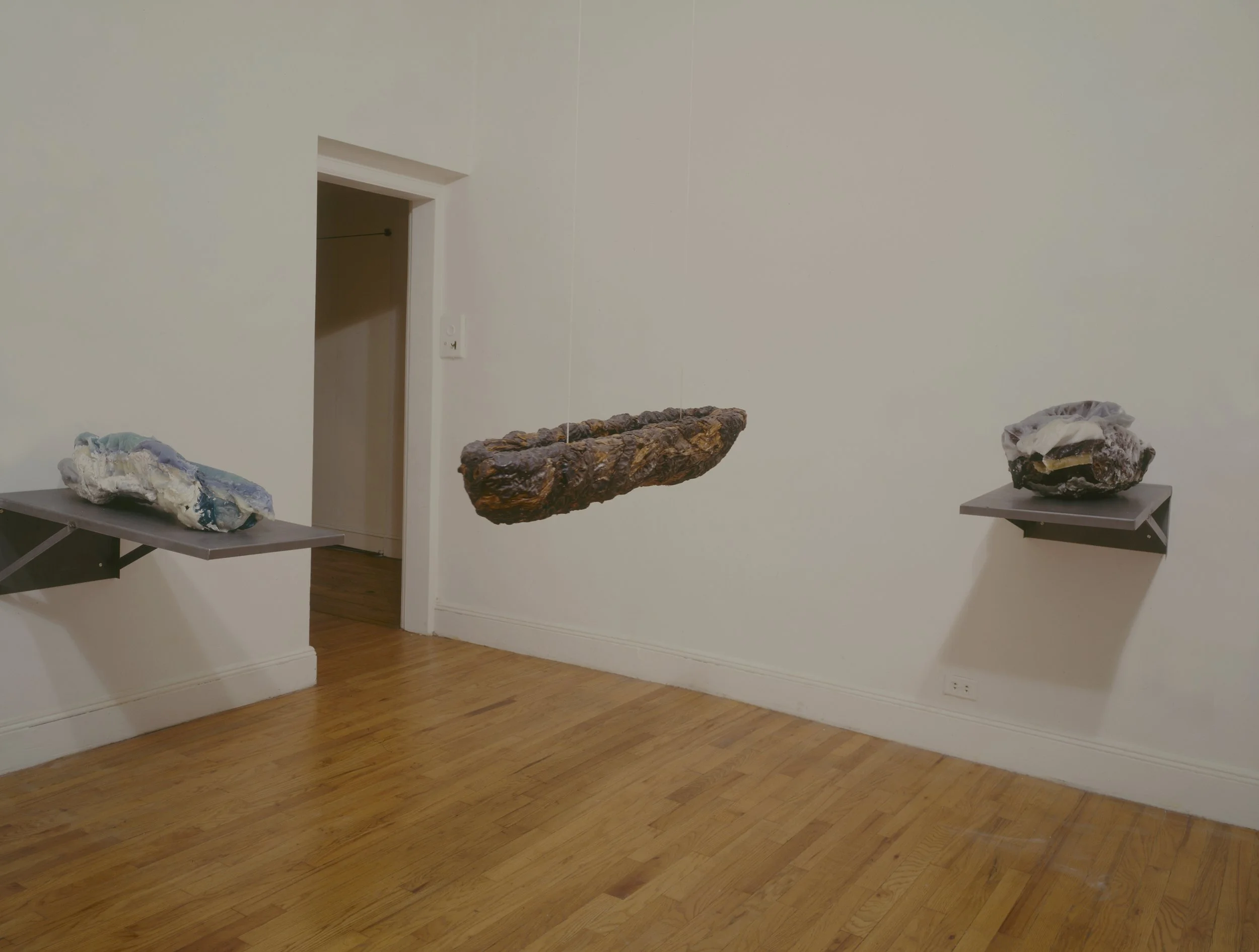
Boats, Installation View, 1986
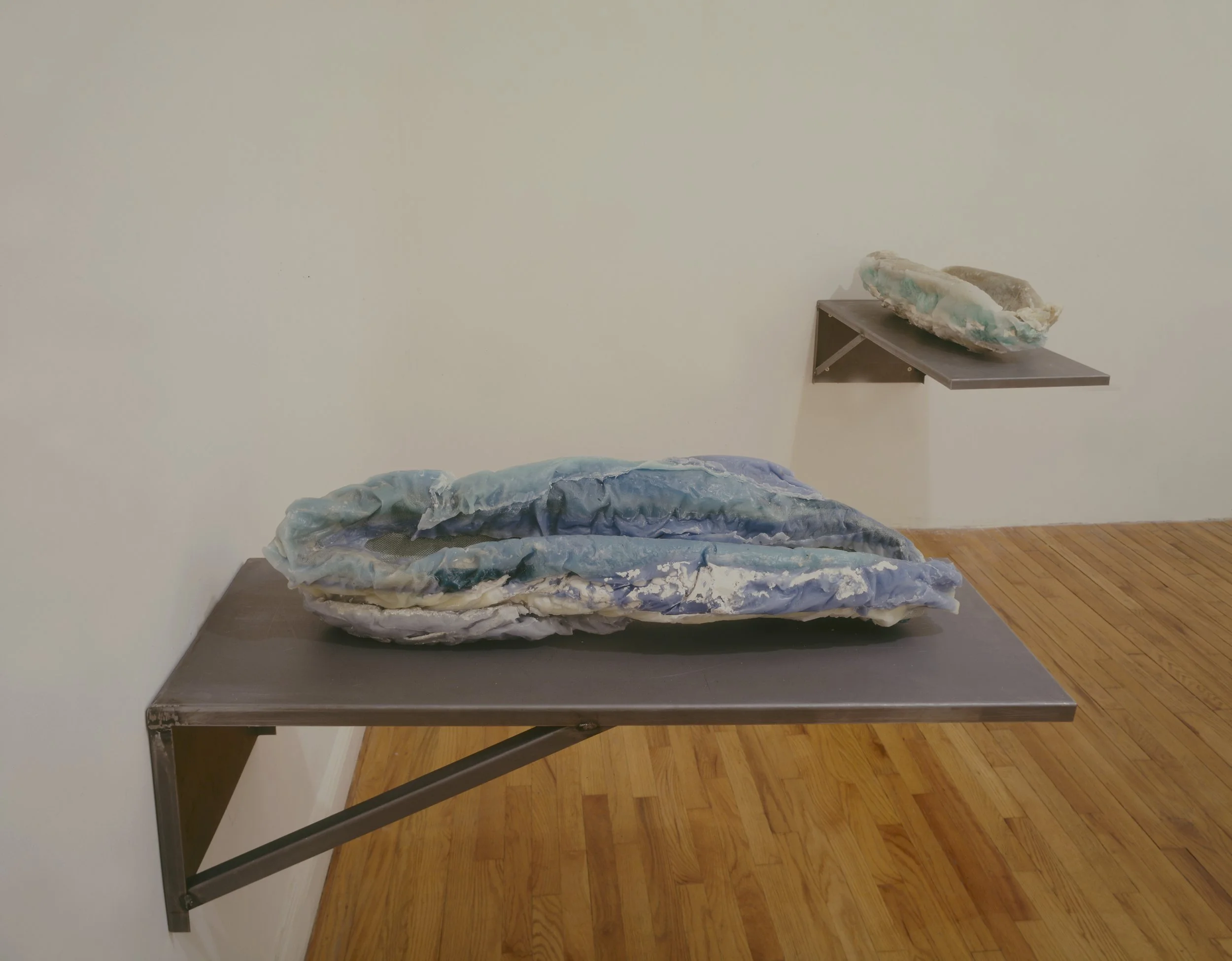
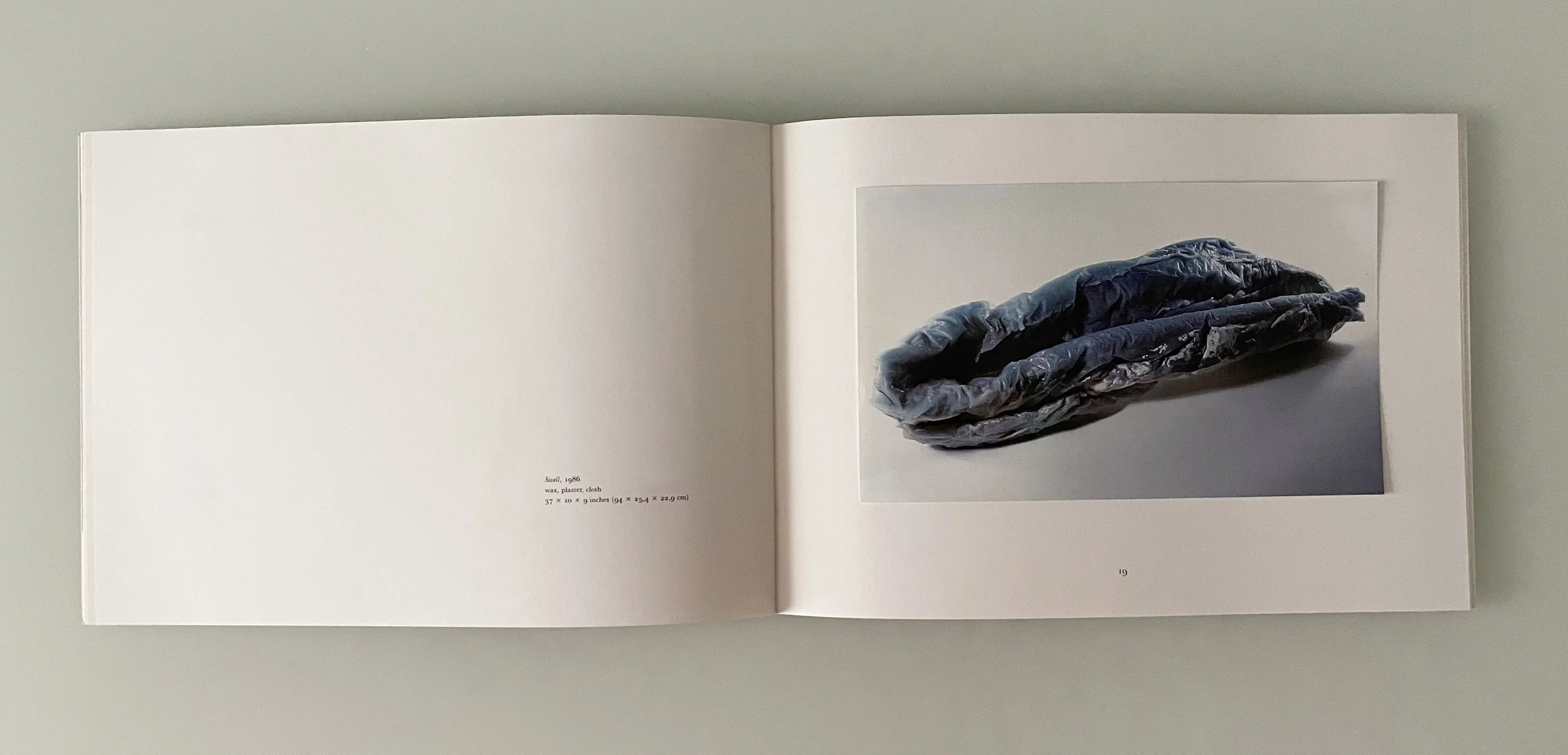
Swell (installation view), wax, plaster, cloth, 37 x 10 x 9”, 1986
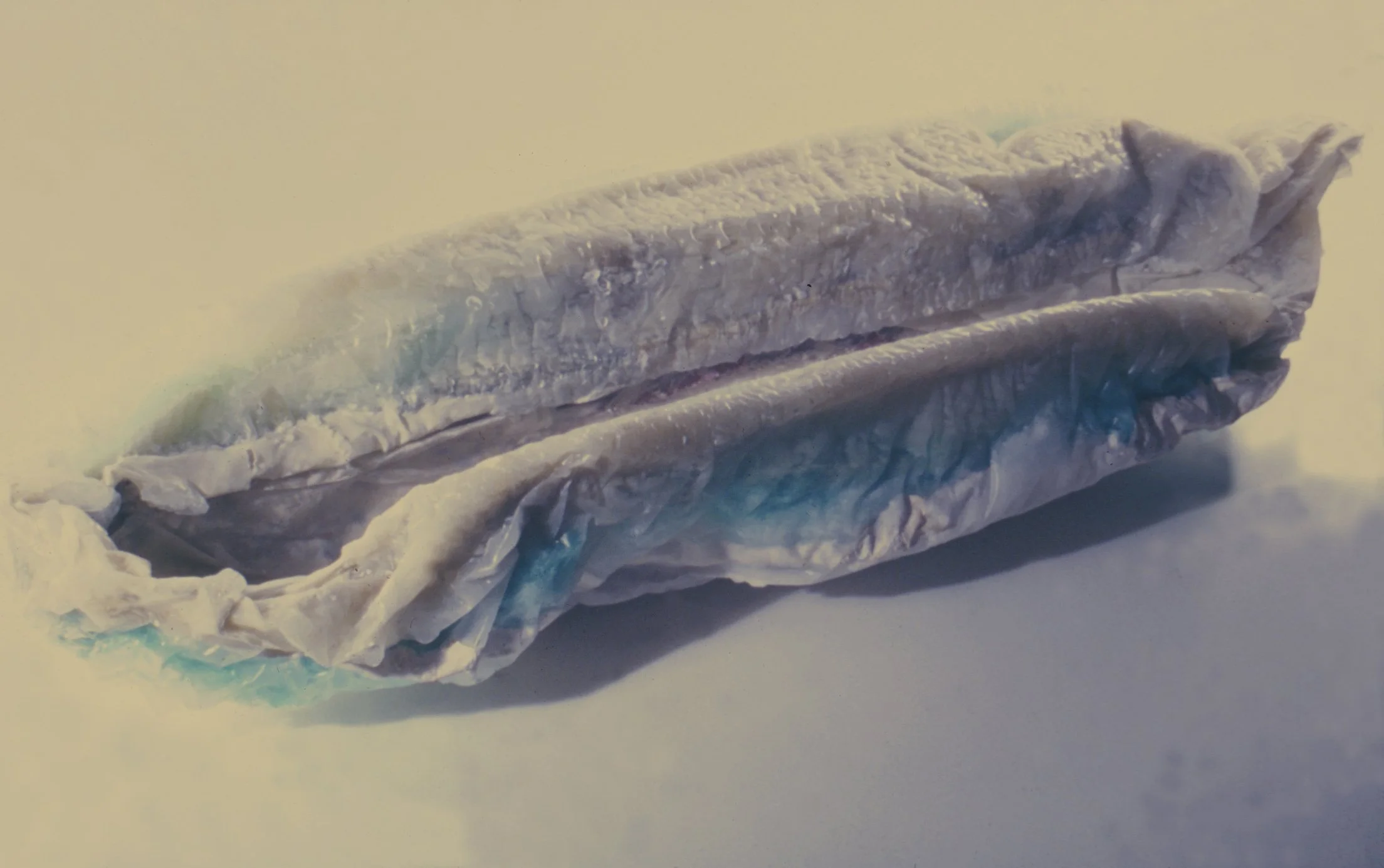
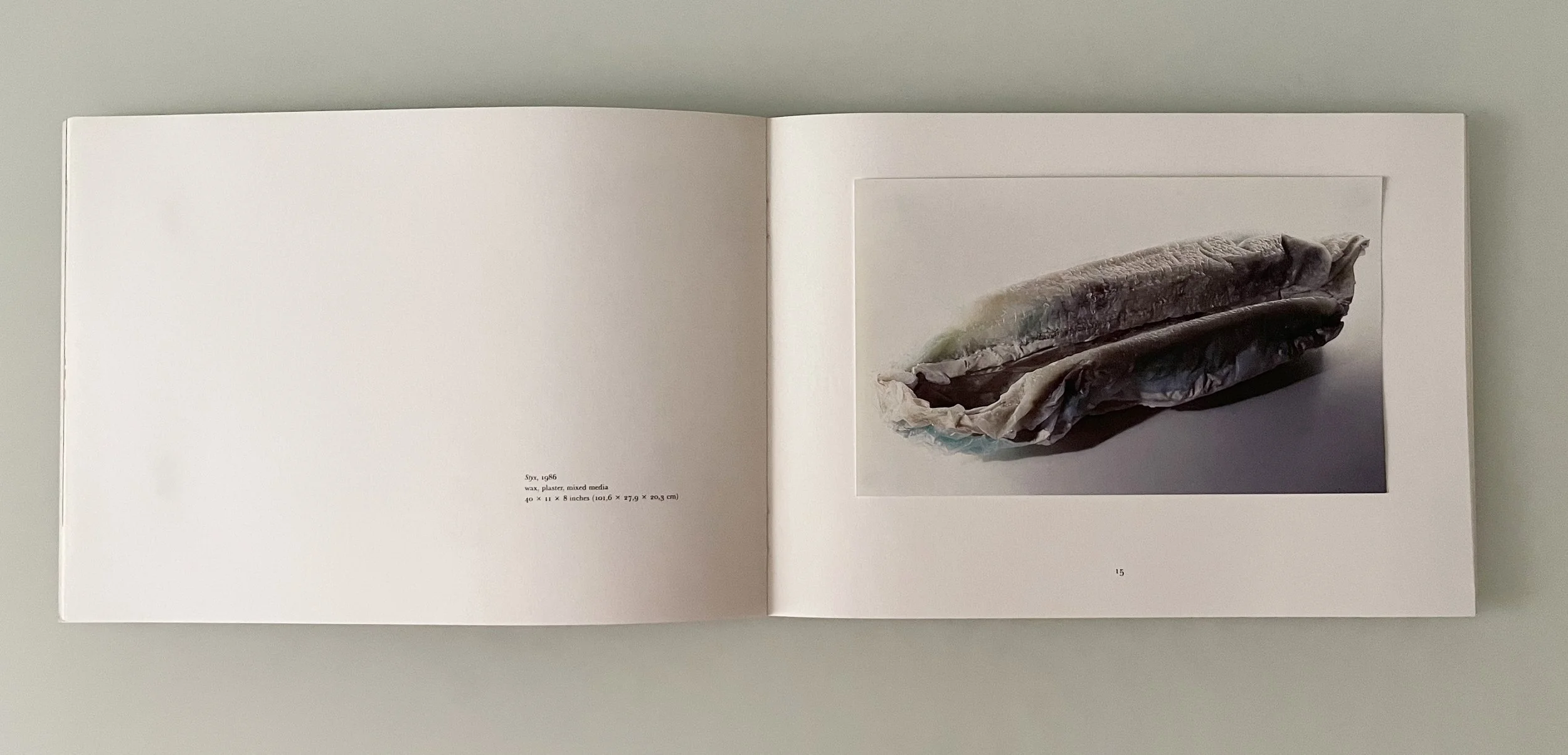
Styx, wax, plaster, mixed media, 40 x 11 x 8” , 1986
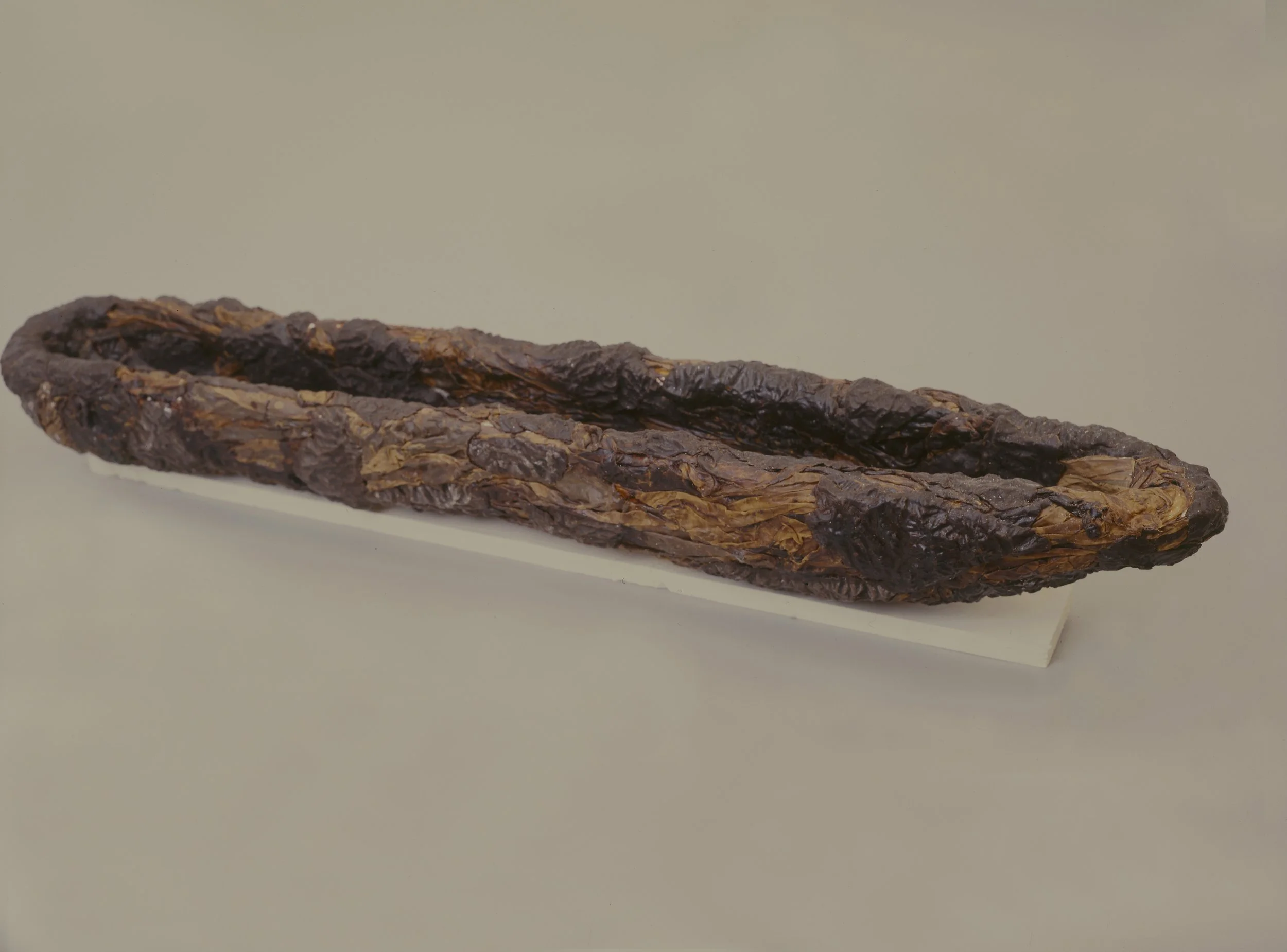
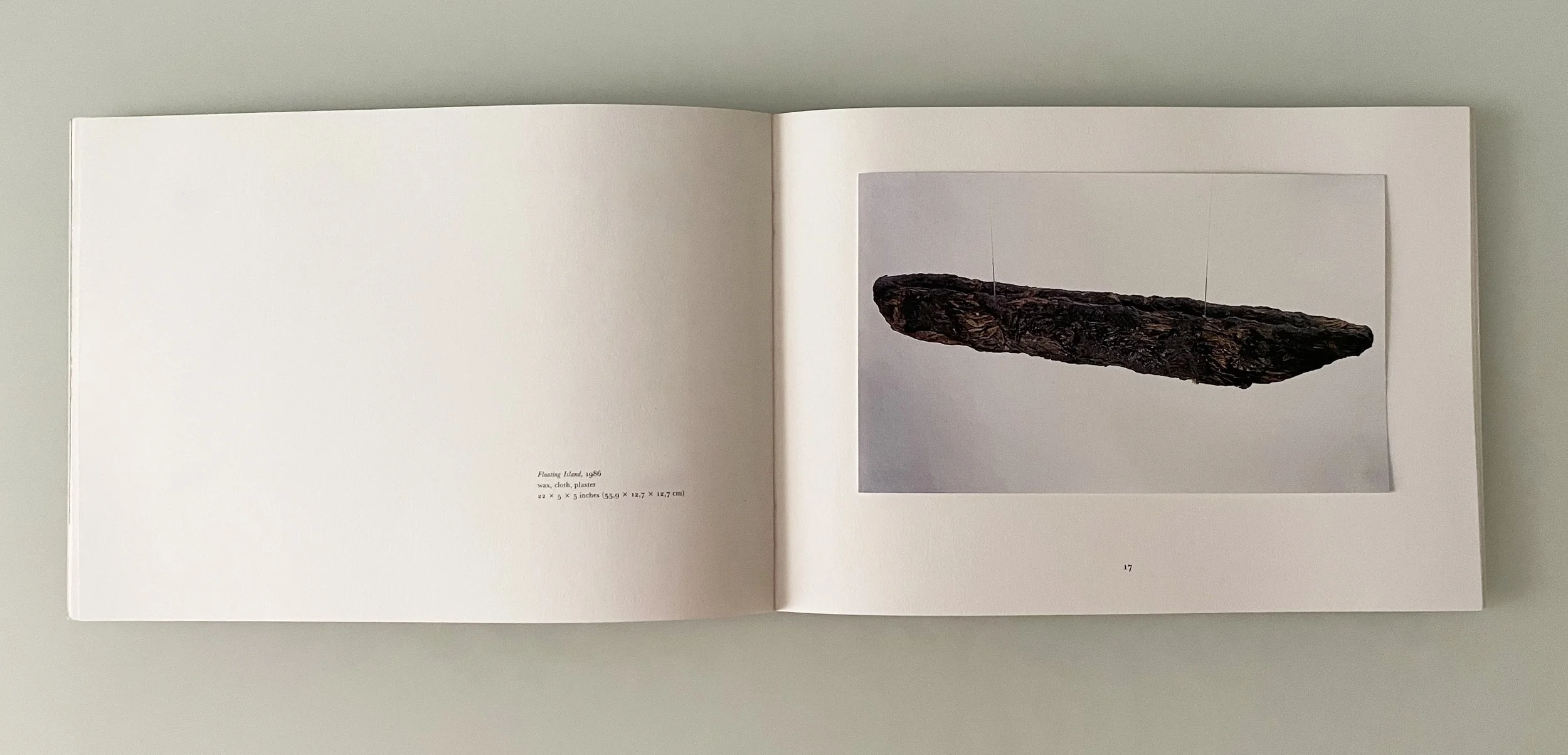
Floating Island, wax, cloth, plaster, 22 x 5 x 5” 1986
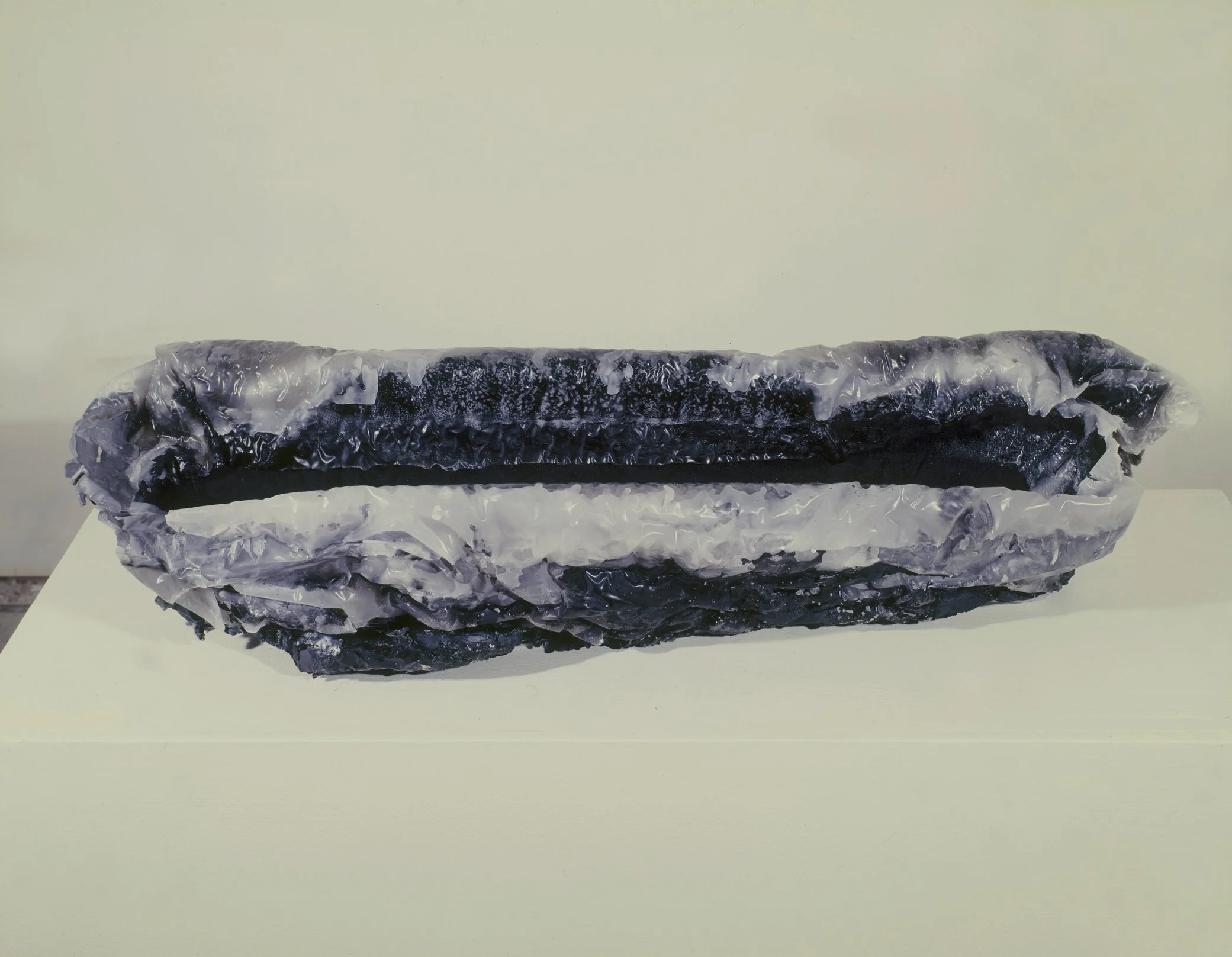
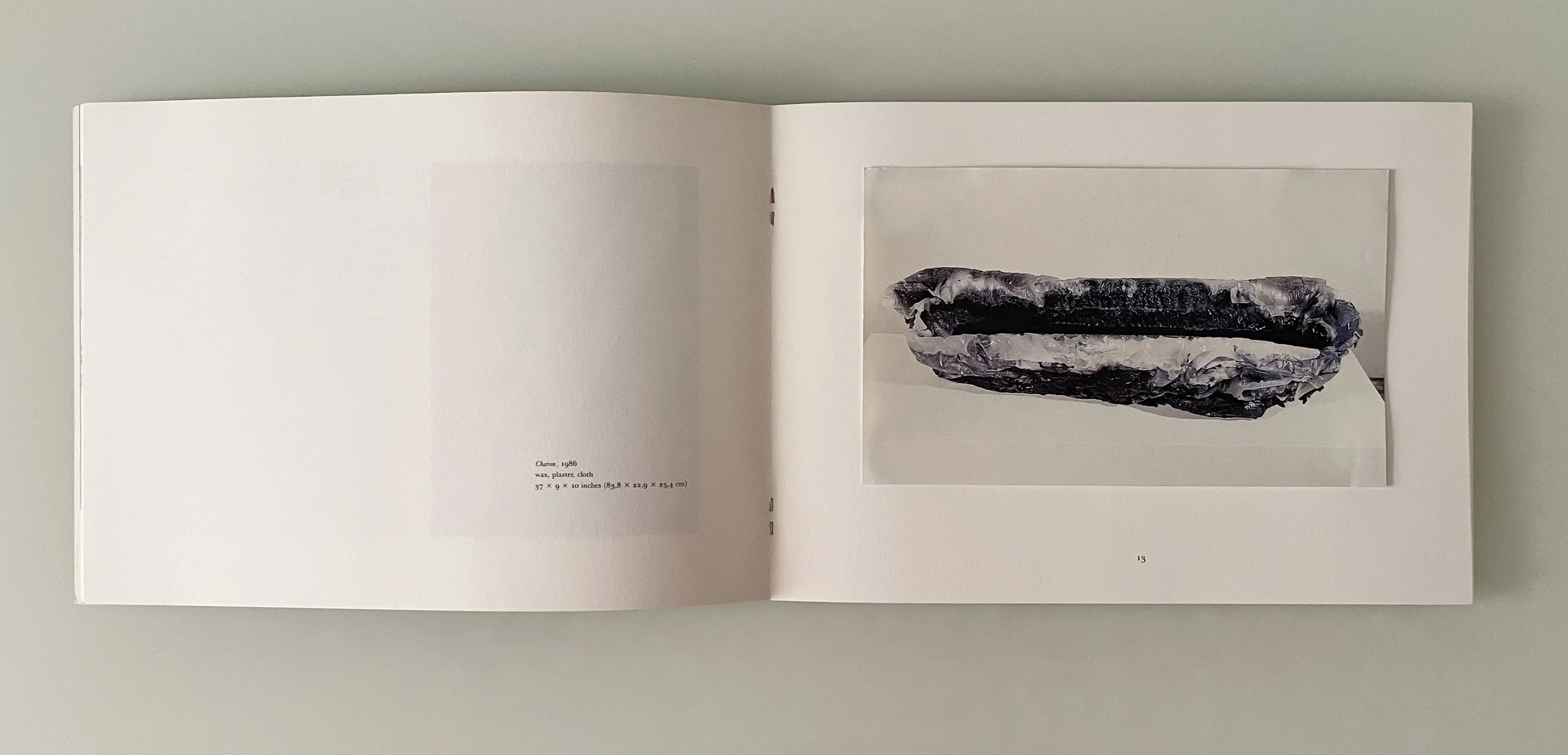
Charon, wax, plaster, cloth, 37 x 9”, 1986
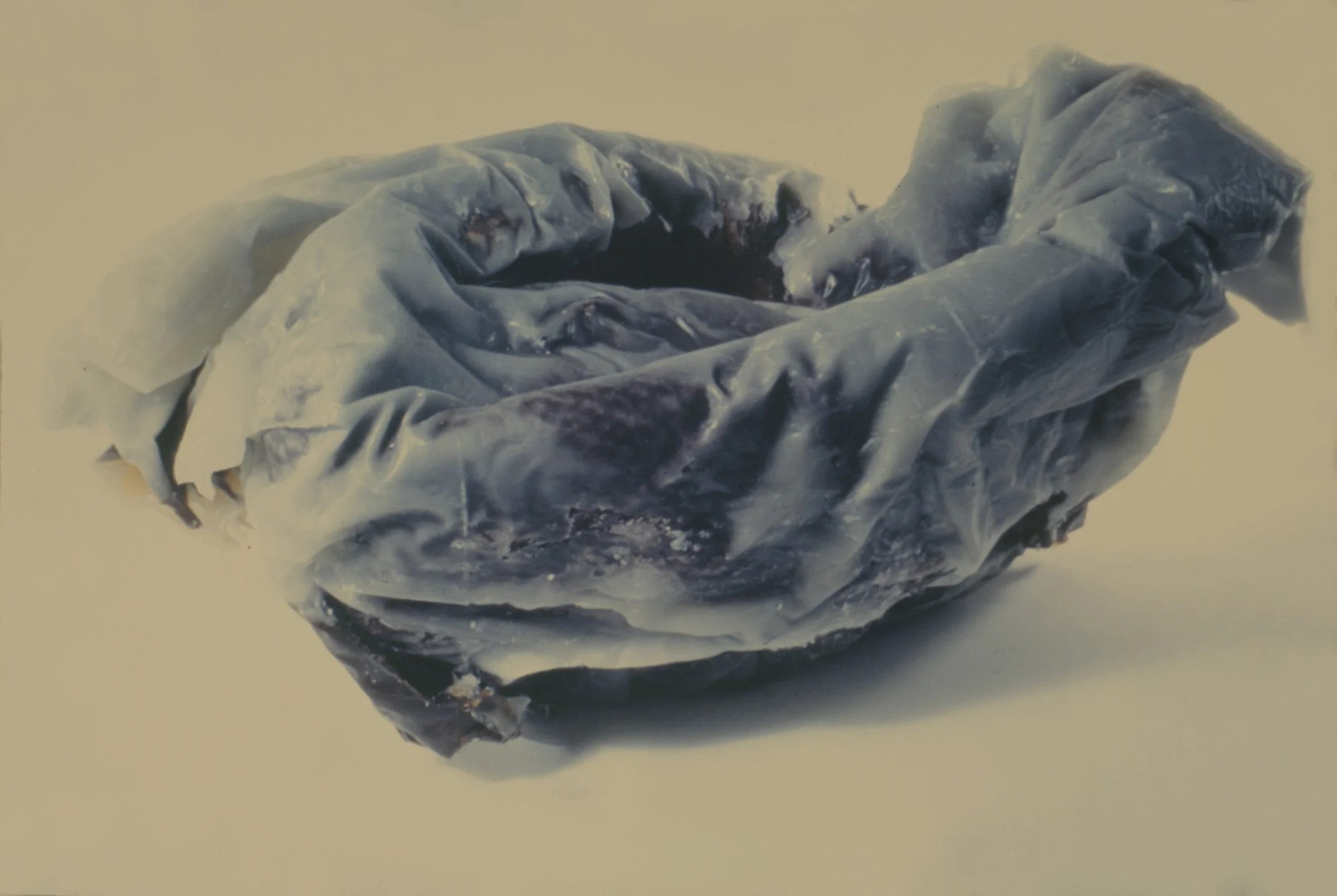
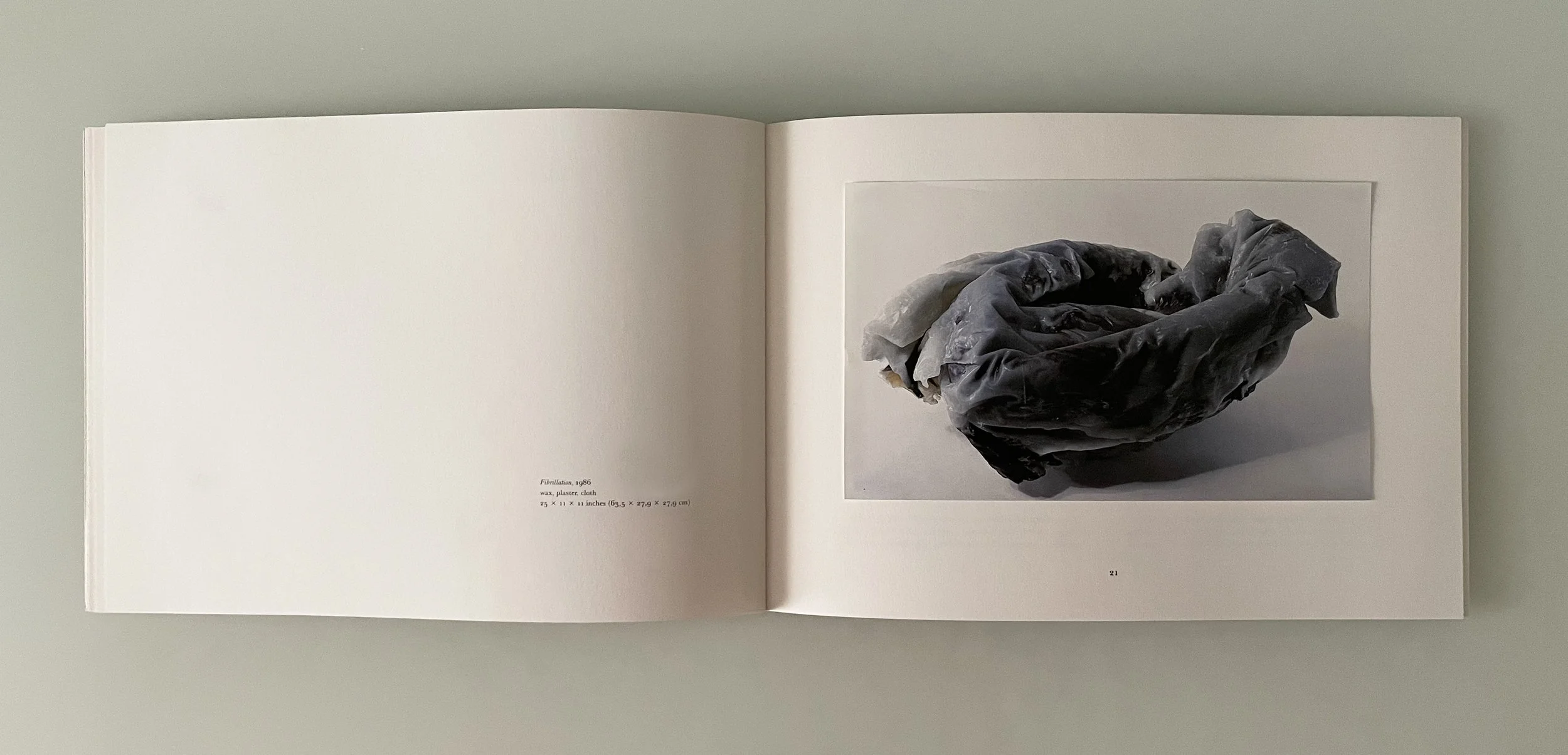
Fibrillation, was, plaster cloth, 25 x 11 x 11, 1986
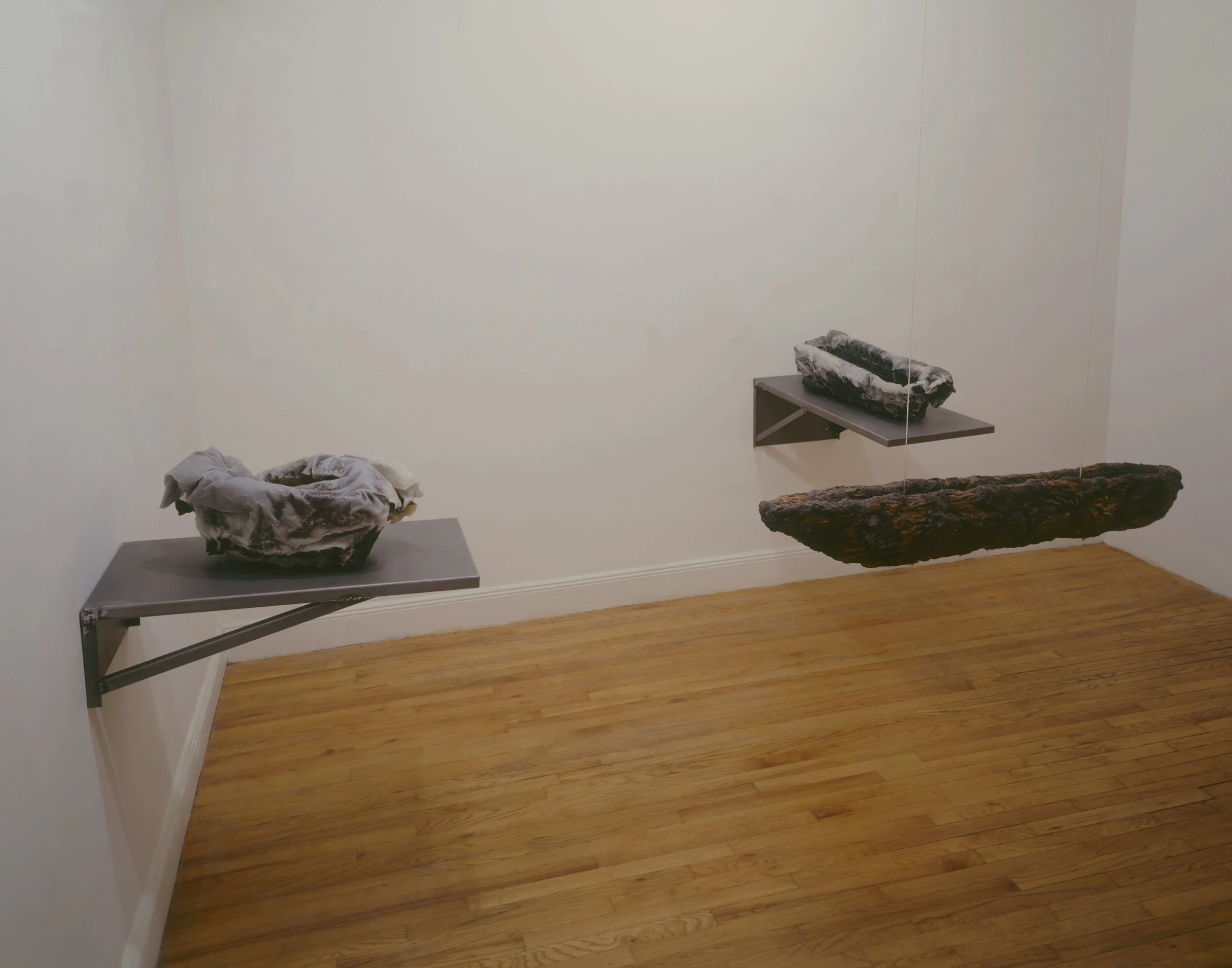
Boats, Installation View, 1986
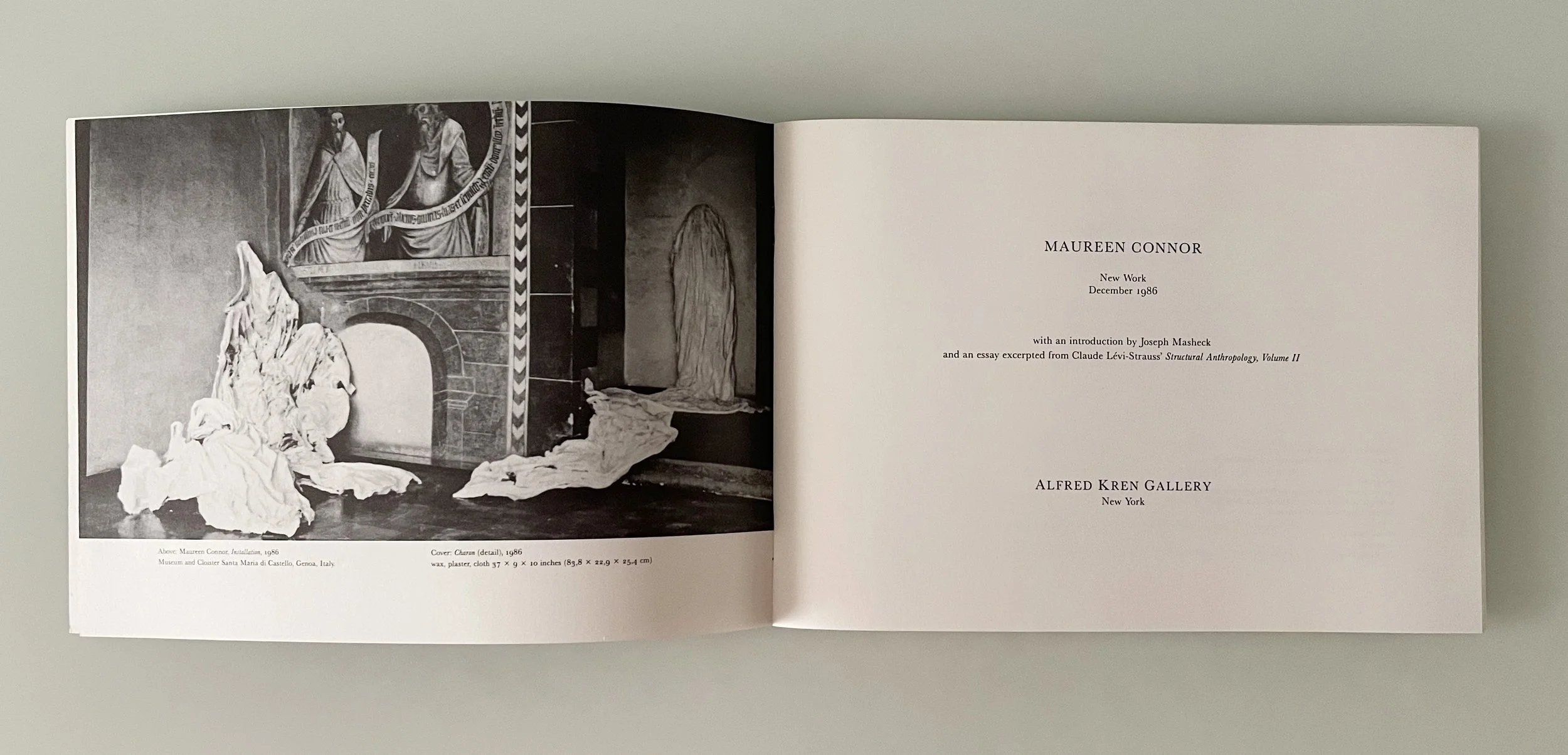
Exhibition Catalog Alfred Kren Gallery, Maureen Connor: New Work, December 1986
Exhibition Catalog Alfred Kren Gallery, Maureen Connor: New Work, December 1986
Exhibition Catalog Alfred Kren Gallery, Maureen Connor: New Work, December 1986
Exhibition Catalog Alfred Kren Gallery, Maureen Connor: New Work, December 1986
Exhibition Catalog Alfred Kren Gallery, Maureen Connor: New Work, December 1986
Exhibition Catalog Alfred Kren Gallery, Maureen Connor: New Work, December 1986
Exhibition Catalog Alfred Kren Gallery, Maureen Connor: New Work, December 1986
Exhibition Catalog Alfred Kren Gallery, Maureen Connor: New Work, December 1986
Exhibition Catalog Alfred Kren Gallery, Maureen Connor: New Work, December 1986
Exhibition Catalog Alfred Kren Gallery, Maureen Connor: New Work, December 1986
Exhibition Catalog Alfred Kren Gallery, Maureen Connor: New Work, December 1986
Exhibition Catalog Alfred Kren Gallery, Maureen Connor: New Work, December 1986
Exhibition Catalog Alfred Kren Gallery, Maureen Connor: New Work, December 1986
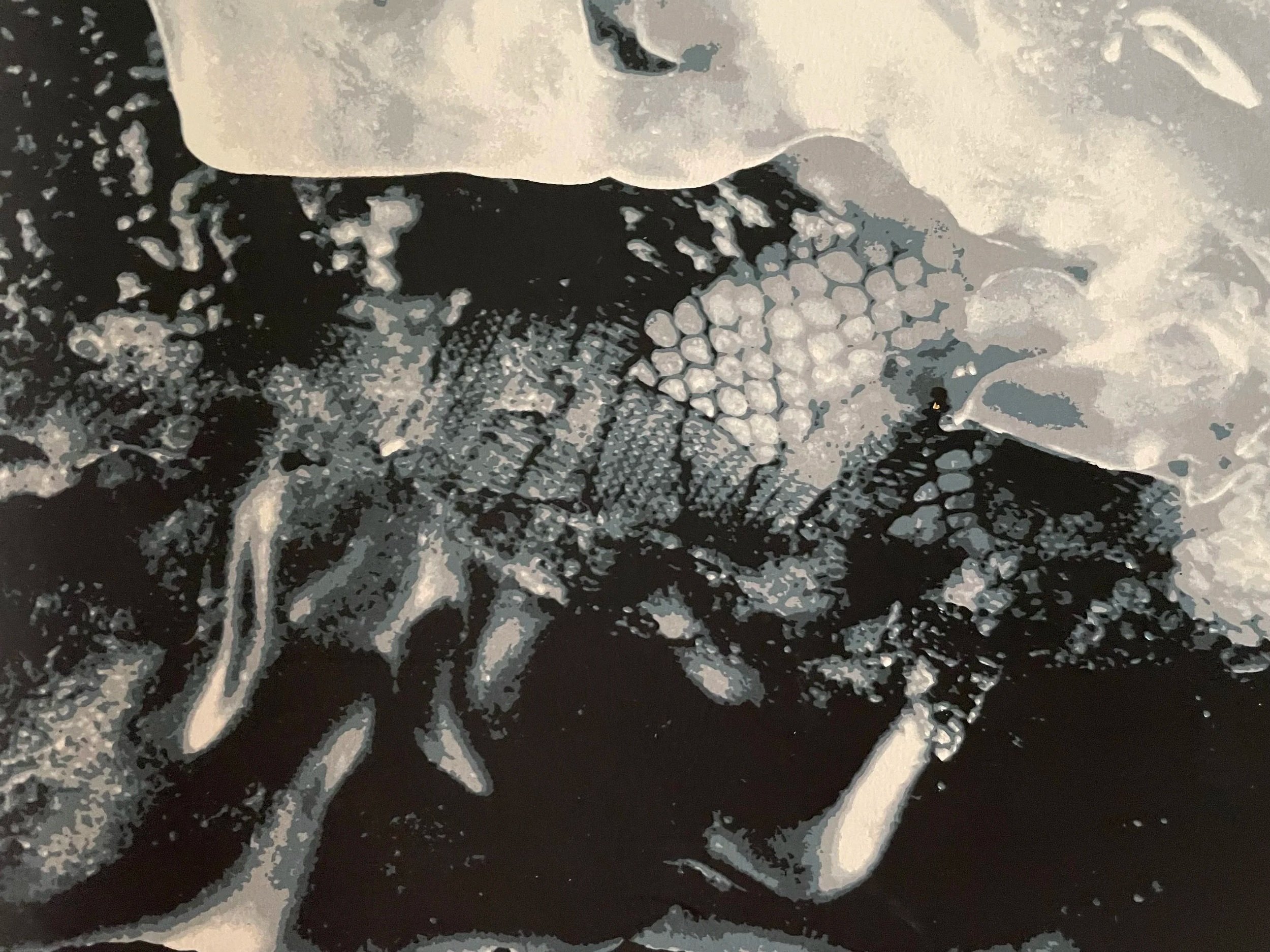
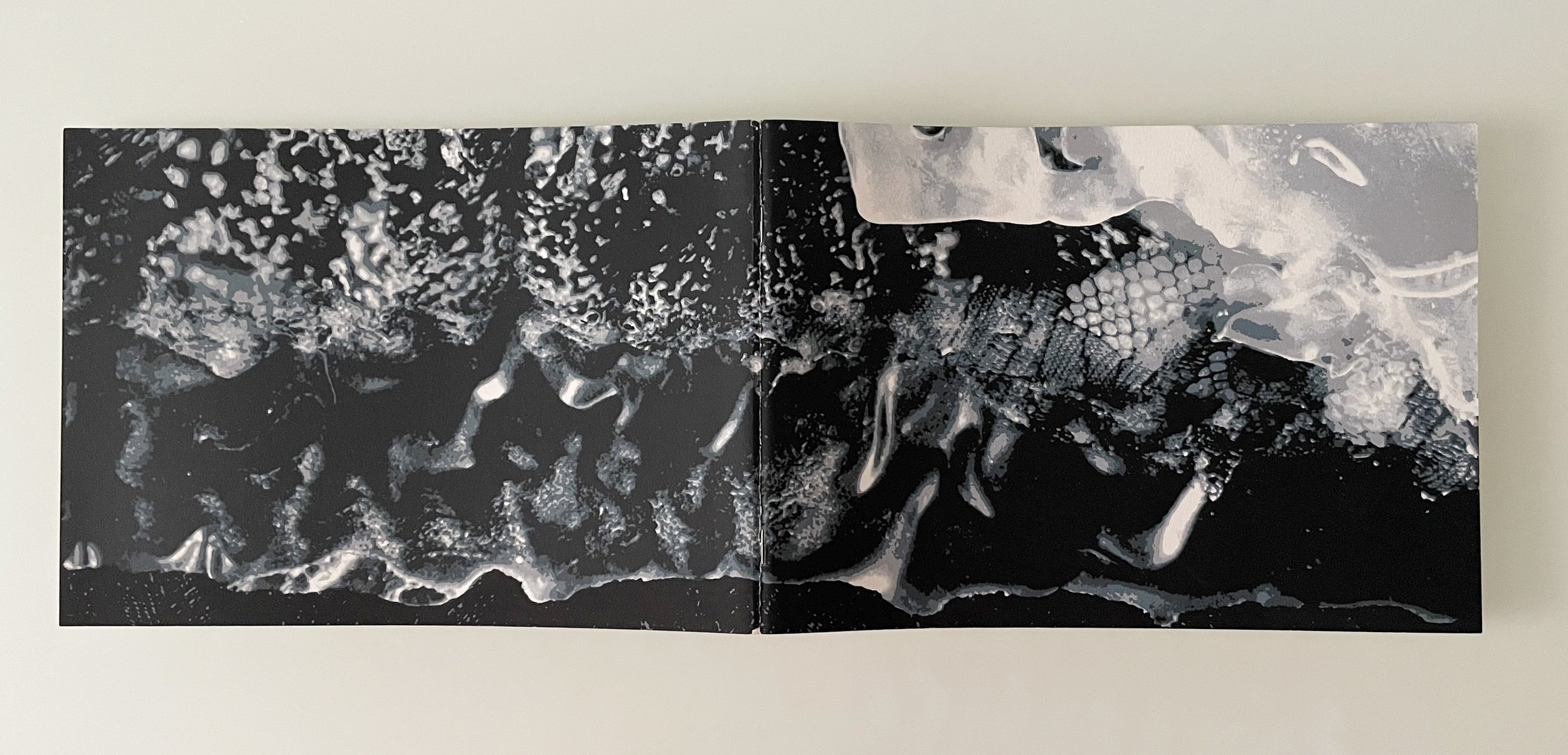
Cover (detail in Charon) Photographs: Jennifer Kotter
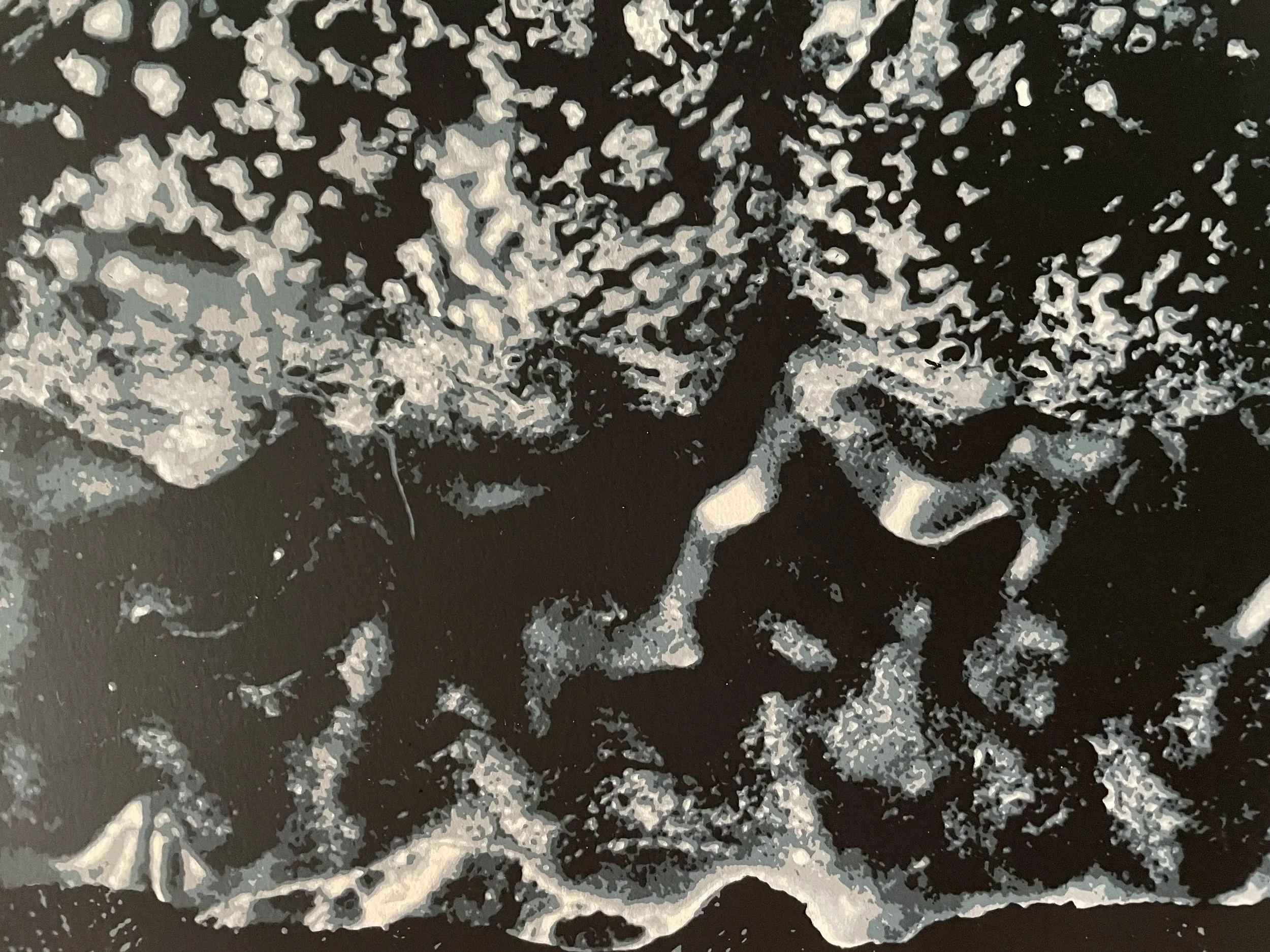
MAUREEN CONNOR
New Work
December 1986
with an introduction by Joseph Masheck
and an essay excerpted from Claude Levi-Strauss' Structural Anthropology, Volume II
ALFRED KREN GALLERY
New York
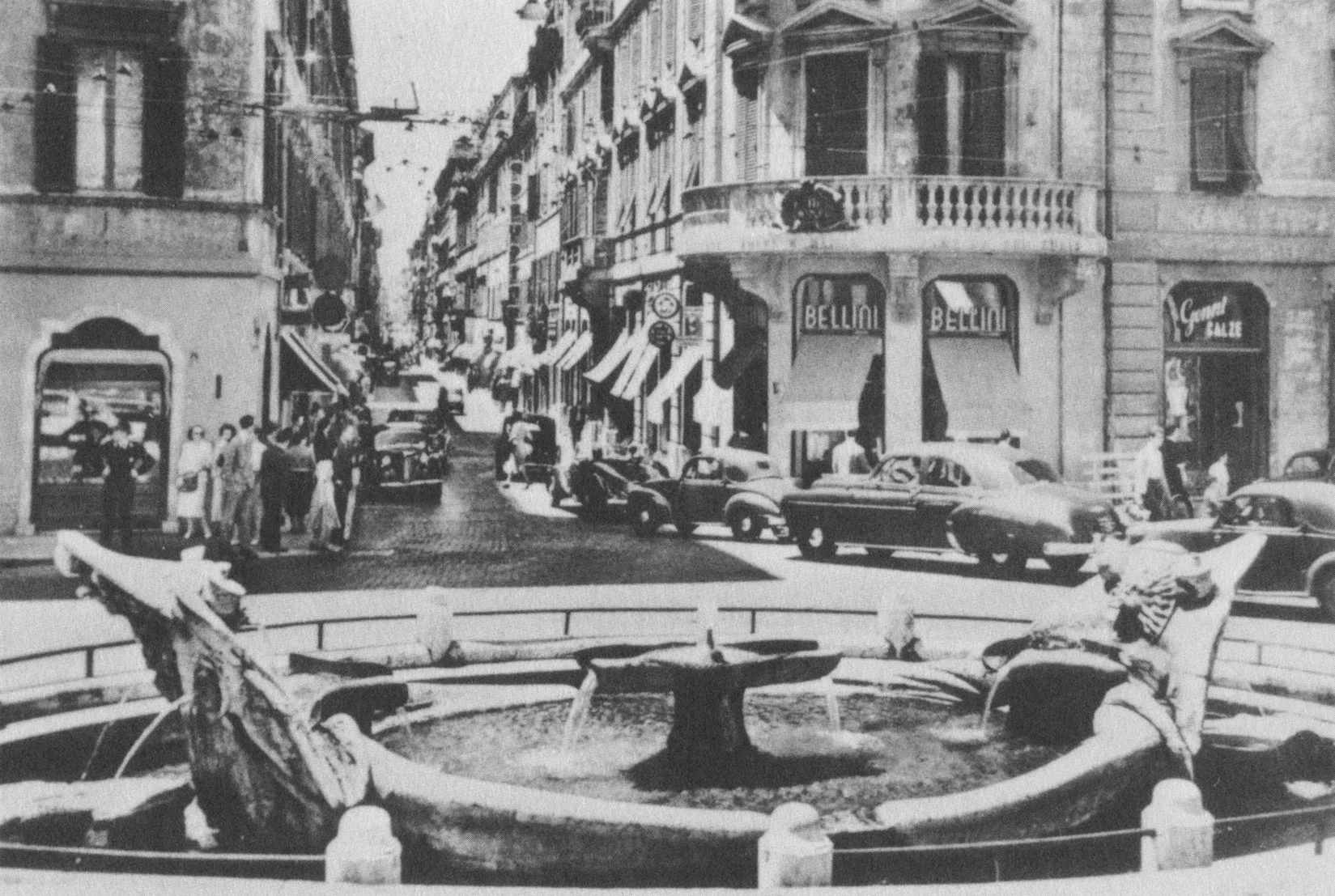
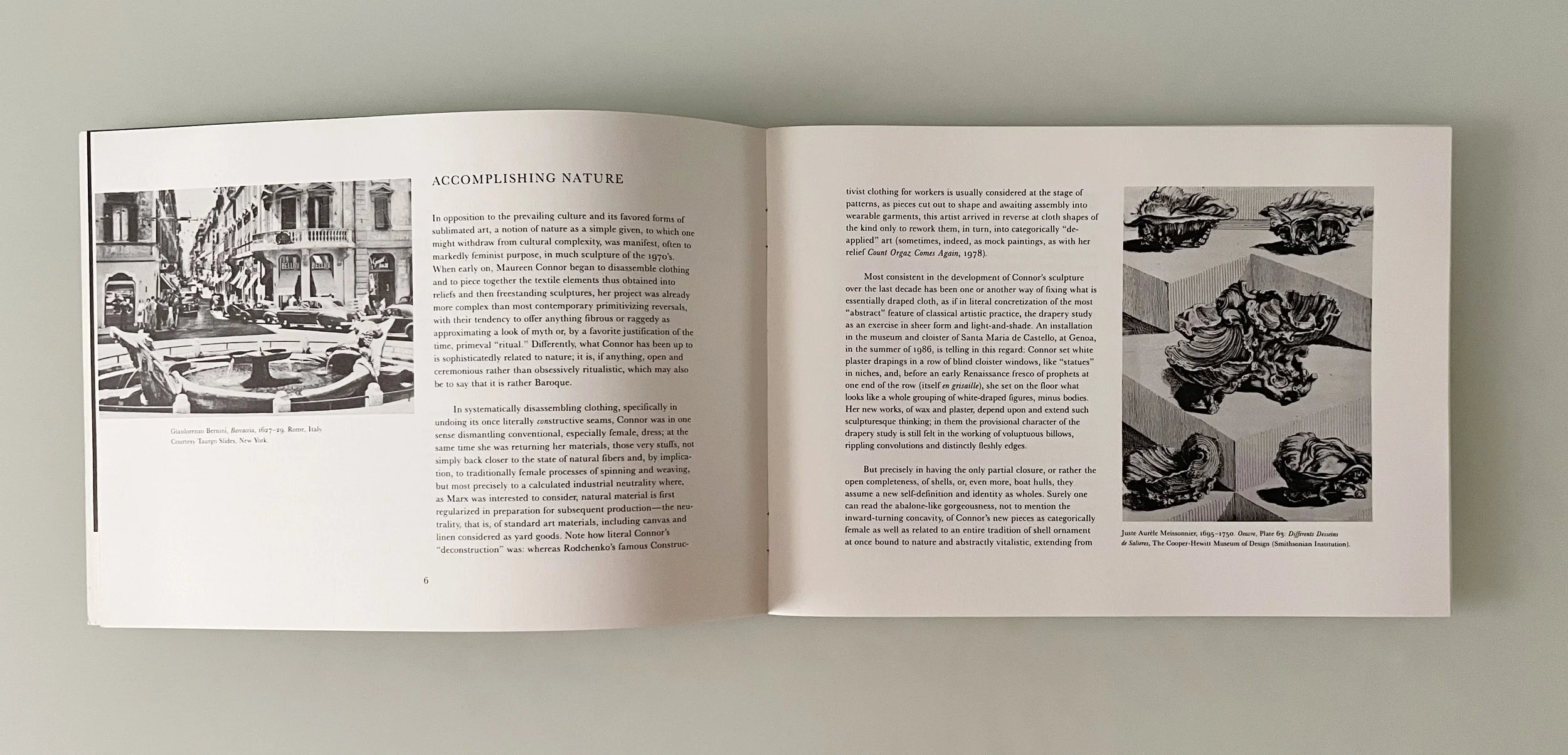
Gianlorenzo Bernini, Barcaccia1 1627-29, Rome, Italy.
Courtesy Taurgo Slides, New York.
ACCOMPLISHING NATURE
In opposition to the prevailing culture and its favored forms of sublimated art, a notion of nature as a simple given, to which one might withdraw from cultural complexity, was manifest, often to markedly feminist purpose, in much sculpture of the 1970's. When early on, Maureen Connor began to disassemble clothing and to piece together the textile elements thus obtained into reliefs and then freestanding sculptures, her project was already more complex than most contemporary primitivizing reversals, with their tendency to offer anything fibrous or raggedy as approximating a look of myth or, by a favorite justification of the time, primeval "ritual." Differently, what Connor has been up to is sophisticatedly related to nature; it is, if anything, open and ceremonious rather than obsessively ritualistic, which may also be to say that it is rather Baroque. In systematically disassembling clothing, specifically in undoing its once literally constructive seams, Connor was in one sense dismantling conventional, especially female, dress; at the same time she was returning her materials, those very stuffs, not simply back closer to the state of natural fibers and, by implication, to traditionally female processes of spinning and weaving, but most precisely to a calculated industrial neutral~ty where, as Marx was interested to consider, natural material is first regularized in preparation for subsequent production-the neutrality, that is, of standard art materials, including canvas and linen considered as yard goods. Note how literal Connor's "deconstruction" was: whereas Rodchenko's famous Constructivist clothing for workers is usually considered at the stage of patterns, as pieces cut out to shape and awaiting assembly into wearable garments, this artist arrived in reverse at cloth shapes of the kind only to rework them, in turn, into categorically "de-applied" art (sometimes, indeed, as mock paintings, as with her relief Count Orgaz Comes Again, 1978).
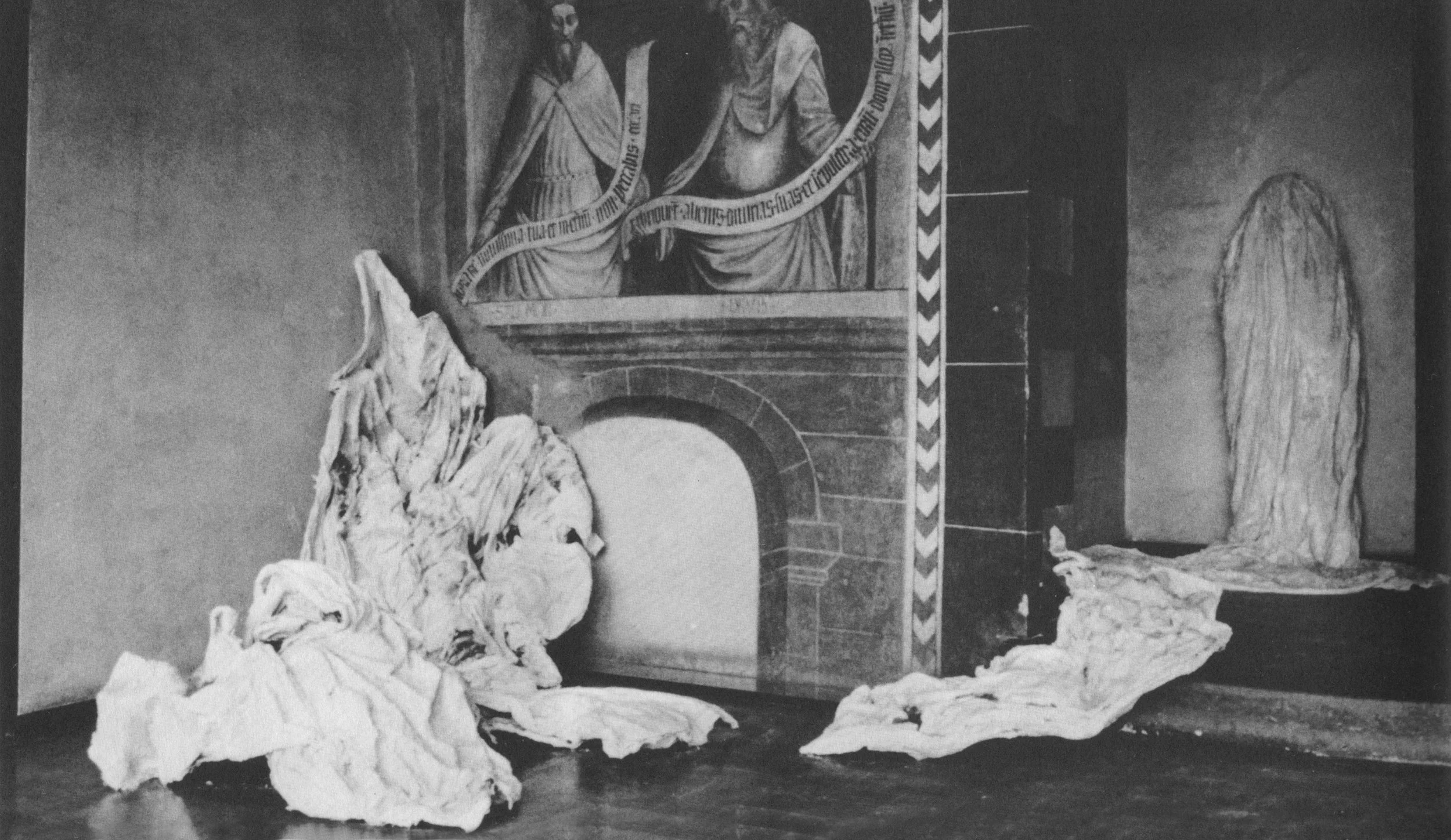
Maureen Connor, Installation, 1986
Museum and Cloister Santa Maria di Castello
Most consistent in the development of Connor's sculpture over the last decade has been one or another way of fixing what is essentially draped cloth, as if in literal concretization of the most "abstract" feature of classical artistic practice, the drapery study as an exercise in sheer form and light-and-shade. An installation in the museum and cloister of Santa Maria de Castello, at Genoa, in the summer of 1986, is telling in this regard: Connor set white plaster drapings in a row of blind cloister windows, like "statues" in niches, and, before an early Renaissance fresco of prophets at one end of the row (itself en grisaille), she set on the floor what looks like a whole grouping of white-draped figures, minus bodies. Her new works, of wax and plaster, depend upon and extend such sculpturesque thinking; in them the provisional character of the drapery study is still felt in the working of voluptuous billows, rippling convolutions and distinctly fleshly edges.
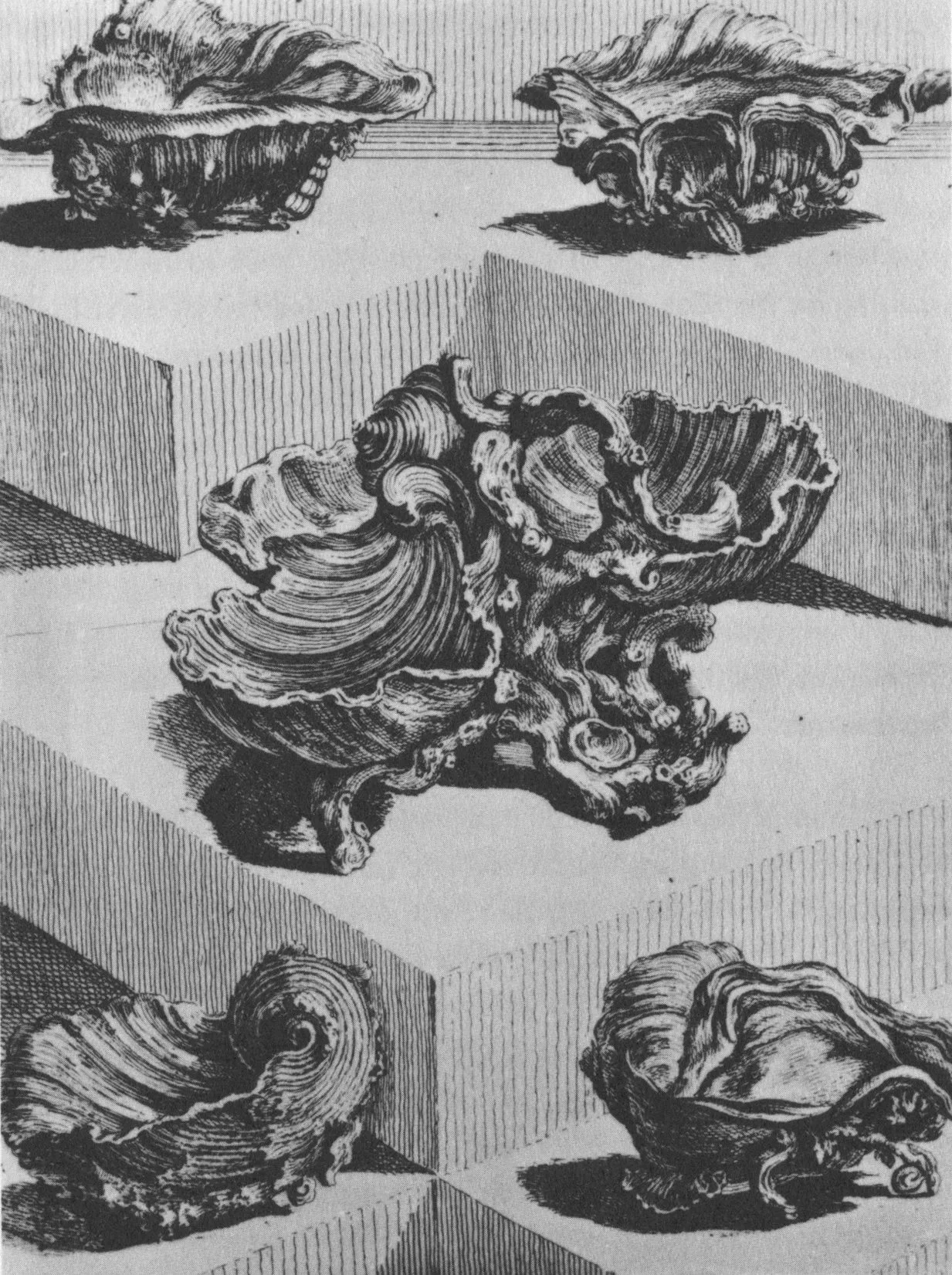
Juste Aurele Meissonnier, 1695-1750.
Oeuvre, Plate 63: Diffirents Desseins de Salieres,
The Cooper-Hewitt Museum of Design (Smithsonian Institution).
But precisely in having the only partial closure, or rather the open completeness, of shells, or, even more, boat hulls, they assume a new self-definition and identity as wholes. Surely one can read the abalone-like gorgeousness, not to mention the inward-turning concavity, of Connor's new pieces as categorically female as well as related to an entire tradition of shell ornament at once bound to nature and abstractly vitalistic, extending from Mannerism through the Baroque to the fantastic extravagances of imaginative designs for objects by Juste Aurele Meissonnier in the Rococo. As to boats, the very way they pertain to the working culture of men while being linguistically considered feminine, may be implicated. There is, too, the hanging of ship models like altar lamps in churches in maritime locales (even in New York), punning on the idea of the architectural "nave" as like a ship (Lat., navis). Before several of Connor's new sculptures one might well recall Bernini's ultimately Baroque fountain in the form of a ship, the Barcaccia (1627-29), itself a concretized metaphor for the Church in the sense of the "ship of state" and a sculpture that has been described as a "strange vessel, a kind of aquatic mutation, [which] combines the ... mouldings of a ship, and fleshy edges, almost as if it were some sort of giant fish"; in a "prodigious fusion of vital forces," it is said, the Barcaccia "approaches" an organic state.1
-
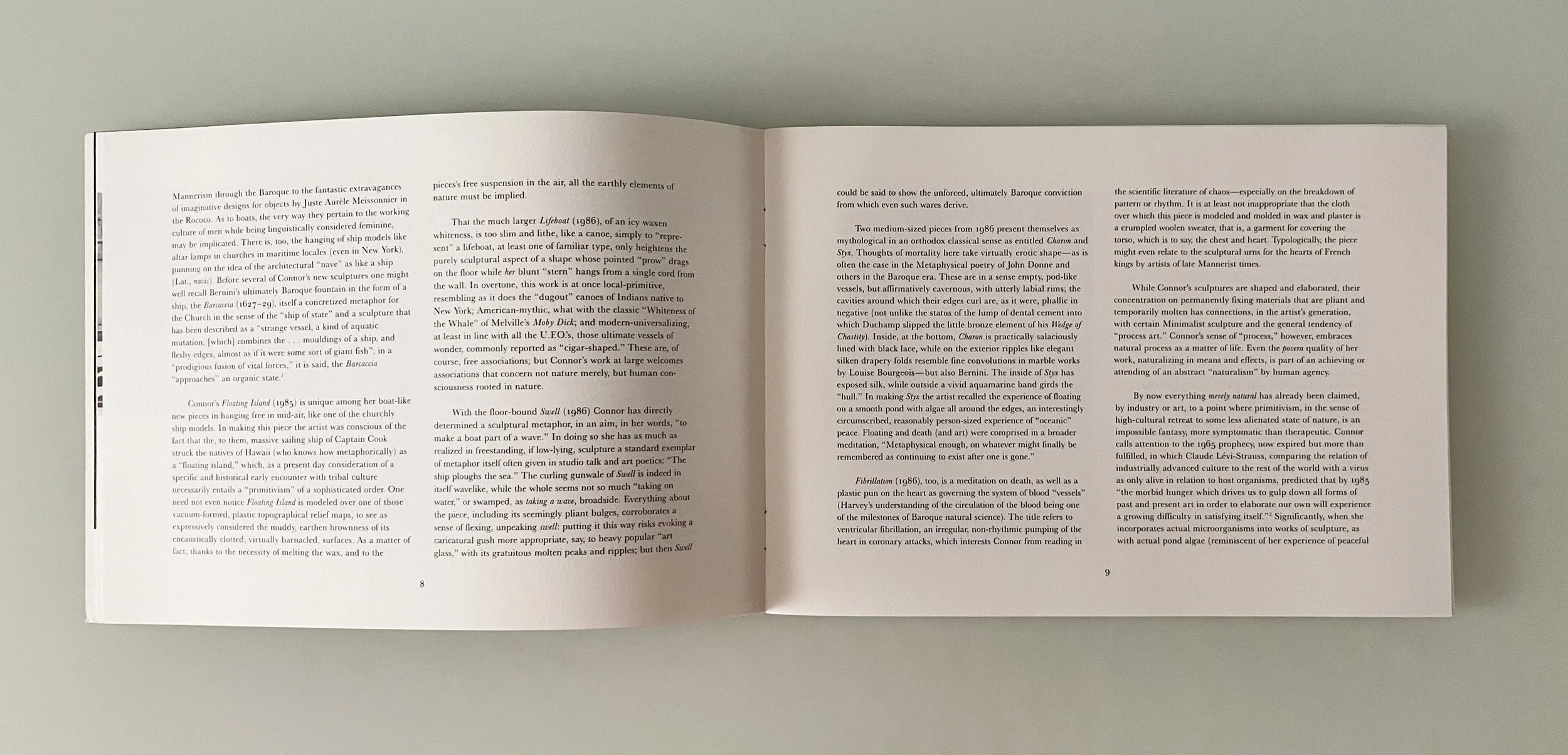
Connor's Floating Island (1985) is unique among her boat-like new pieces in hanging free in mid-air, like one of the churchly ship models. In making this piece the artist was conscious of the fact that the, to them, massive sailing ship of Captain Cook struck the natives of Hawaii (who knows how metaphorically) as a "floating island," which, as a present day consideration of a specific and historical early encounter with tribal culture necessarily entails a "primitivism" of a sophisticated order. One need not even notice Floating Island is modeled over one of those vacuum-formed, plastic topographical relief maps, to see as expressively considered the muddy, earthen brownness of its encaustically clotted, virtually barnacled, surfaces. As a matter of fact, thanks to the necessity of melting the wax, and to the pieces's free suspension in the air, all the earthly elements of nature must be implied.
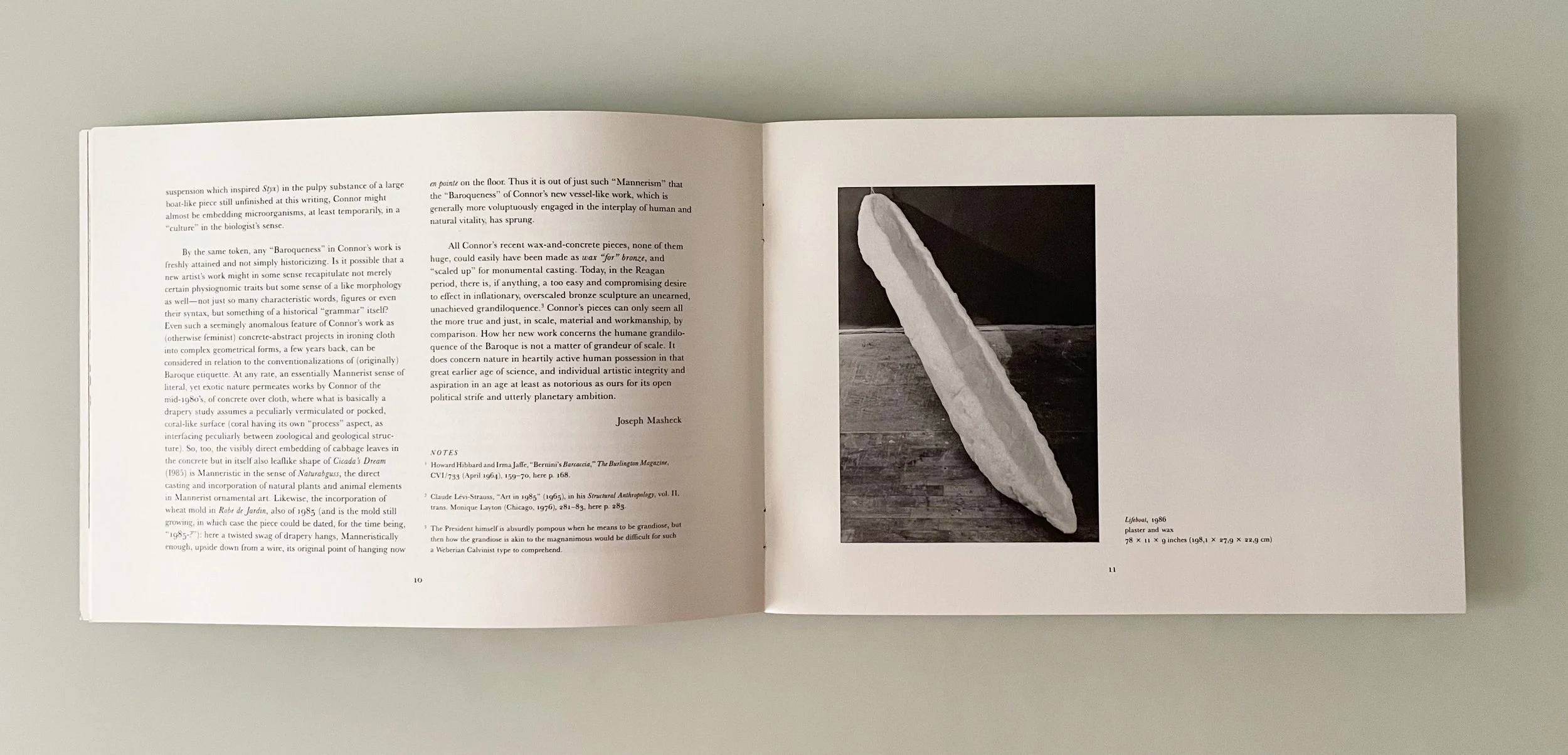
That the much larger Lifeboat (1986), of an icy waxen whiteness, is too slim and lithe, like a canoe, simply to "represent" a lifeboat, at least one of familiar type, only heightens the purely sculptural aspect of a shape whose pointed "prow'· drags on the floor while her blunt "stern" hangs from a single cord from the wall. In overtone, this work is at once local-primitive, resembling as it does the "dugout" canoes of Indians native to New York; American-mythic, what with the classic "Whiteness of the Whale" of Melville's Moby Dick; and modern-universalizing, at least in line with all the U.F.O.'s, those ultimate vessels of wonder, commonly reported as "cigar-shaped." These are, of course, free associations; but Connor's work at large welcomes associations that concern not nature merely, but human consciousness rooted in nature.
With the floor-bound Swell (1986) Connor has directly determined as sculptural metaphor, in an aim, in her words, "to make a boat part of a wave." In doing so she has as much as realized in freestanding, if low-lying, sculpture a standard exemplar of metaphor itself often given in studio talk and art poetics: "The ship ploughs the sea." The curling gunwale of Swell is indeed in itself wavelike, while the whole seems not so much "taking on water," or swamped, as taking a wave, broadside. Everything about the piece, including its seemingly pliant bulges, corroborates a sense of flexing, unspeaking swell: putting it this way risks evoking a caricatural gush more appropriate, say, to heavy popular "art glass," with its gratuitous molten peaks and ripples; but then Swell (1986) could be said to show the unforced, ultimately Baroque conviction from which even such wares derive.
Two medium-sized pieces from 1986 present themselves as mythological in an orthodox classical sense as entitled Charon and Styx. Thoughts of mortality here take virtually erotic shape-as is often the case in the Metaphysical poetry ofJohn Donne and others in the Baroque era. These are in a sense empty, pod-like vessels, but affirmatively cavernous, with utterly labial rims; the cavities around which their edges curl are, as it were, phallic in negative (not unlike the status of the lump of dental cement into which Duchamp slipped the little bronze element of his Wedge of Chastity}. Inside, at the bottom, Charon is practically salaciously lined with black lace, while on the exterior ripples like elegant silken drapery folds resemble fine convolutions in marble works by Louise Bourgeois-but also Bernini. The inside of Styx has exposed silk, while outside a vivid aquamarine band girds the ''hull." In making Styx the artist recalled the experience of floating on a smooth pond with algae all around the edges, an interestingly circumscribed, reasonably person-sized experience of "oceanic.. peace. Floating and death (and art} were comprised in a broader meditation, "Metaphysical enough, on whatever might finally be remembered as continuing to exist after one is gone."
Fibrillation (1986), too, is a meditation on death, as well as a plastic pun on the heart as governing the system of blood "vessels" (Harvey's understanding of the circulation of the blood being one of the milestones of Baroque natural science). The title refers to ventricular fibrillation, an irregular, non-rhythmic pumping of the heart in coronary attacks, which interests Connor from reading in the scientific literature of chaos-especially on the breakdown of pattern or rhythm. It is at least not inappropriate that the cloth over which this piece is modeled and molded in wax and plaster is a crumpled woolen sweater, that is, a garment for covering the torso, which is to say, the chest and heart. Typologically, the piece might even relate to the sculptural urns for the hearts of French kings by artists of late mannerist times.
While Connor's sculptures are shaped and elaborated, their concentration on permanently fixing materials that are pliant and temporarily molten has connections, in the artist's generation, with certain Minimalist sculpture and the general tendency of "process art." Connor's sense of"process," however, embraces natural process as a matter of life. Even the povera quality of her work, naturalizing in means and effects, is part of an achieving or attending of an abstract "naturalism" by human agency.
By now everything merely natural has already been claimed, by industry or art, to a point where primitivism, in the sense of high-cultural retreat to some less alienated state of nature, is an impossible fantasy, more symptomatic than therapeutic. Connor calls attention to the 1965 prophecy, now expired but more than fulfilled, in which Claude Levi-Strauss, comparing the relation of industrially advanced culture to the rest of the world with a virus as only alive in relation to host organisms, predicted that by 1985 "the morbid hunger which drives us to gulp down all forms of past and present art in order to elaborate our own will experience a growing difficulty in satisfying itself."2 Significantly, when she incorporates actual microorganisms into works of sculpture, as with actual pond algae (reminiscent of her experience of peaceful suspension which inspired Styx) in the pulpy substance of a large boat-like piece still unfinished at this writing, Connor might almost be embedding microorganisms, at least temporarily, in a "culture" in the biologist's sense.
By the same token, any "Baroqueness" in Connor's work is freshly attained and not simply historicizing. Is it possible that a new artist's work might in some sense recapitulate not merely certain physiognomic traits but some sense of a like morphology as well-not just so many characteristic words, figures or even their syntax, but something of a historical "grammar" itself. Even such a seemingly anomalous feature of Connor's work as (otherwise feminist) concrete-abstract projects in ironing cloth into complex geometrical forms, a few years back, can be considered in relation to the conventionalizations of (originally) Baroque etiquette. At any rate, an essentially Mannerist sense of literal, yet exotic nature permeates works by Connor of the mid-198o's, of concrete over cloth, where what is basically a drapery study assumes a peculiarly vermiculated or pocked, coral-like surface (coral having its own "process" aspect, as interfacing peculiarly between zoological and geological structure). So, too, the visibly direct embedding of cabbage leaves in the concrete but in itself also leaflike shape of Cicada's Dream (1985) is Manneristic in the sense of Naturabguss, the direct casting and incorporation of natural plants and animal elements in Mannerist ornamental art. Likewise, the incorporation of wheat mold in Robe de Jardin, also of 1985 (and is the mold still growing, in which case the piece could be dated, for the time being, "1985-?"): here a twisted swag of drapery hangs, Manneristically enough, upside down from a wire, its original point of hanging now en pointe on the floor. Thus it is out of just such "Mannerism" that the "Baroqueness" of Connor's new vessel-like work, which is generally more voluptuously engaged in the interplay of human and natural vitality, has sprung.
All Connor's recent wax-and-concrete pieces, none of them huge, could easily have been made as wax ''for" bronze, and "scaled up" for monumental casting. Today, in the Reagan period, there is, if anything, a too easy and compromising desire to effect in inflationary, overscaled bronze sculpture an unearned, unachieved grandiloquence.3 Connor's pieces can only seem all the more true and just, in scale, material and workmanship, by comparison. How her new work concerns the humane grandiloquence of the Baroque is not a matter of grandeur of scale. It does concern nature in heartily active human possession in that great earlier age of science, and individual artistic integrity and aspiration in an age at least as notorious as ours for its open political strife and utterly planetary ambition.
Joseph Masheck
NOTES
1. Howard Hibbard and Irma Jaffe,"Bernini's Barcaccia,"The Burlington Magazine, CVI / 733 (April 1964), 159-70, here p. 168.
2. Claude Levi-Strauss, "Art in 1985" (1965), in his Structural Anthropology. vol. II, trans. Monique Layton {Chicago, 1976), 281-83, here p. 283.
3. The President himself is absurdly pompous when he means to be grandiose, but then how the grandiose is akin to the magnanimous would be difficult for such a Weberian Calvinist type to comprehend.
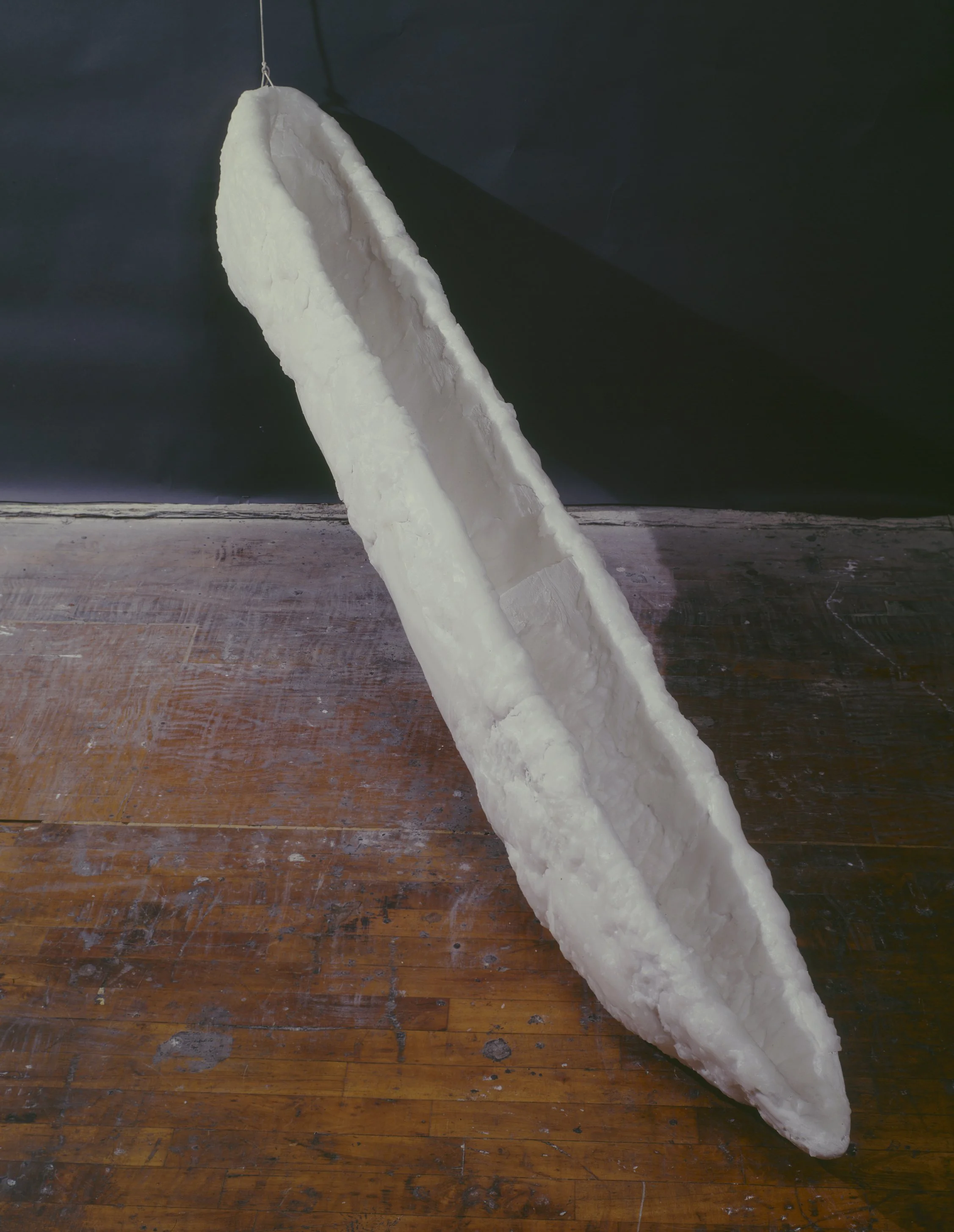
Lifeboat, 1986, plaster and wax, 78 x 11 x 9”
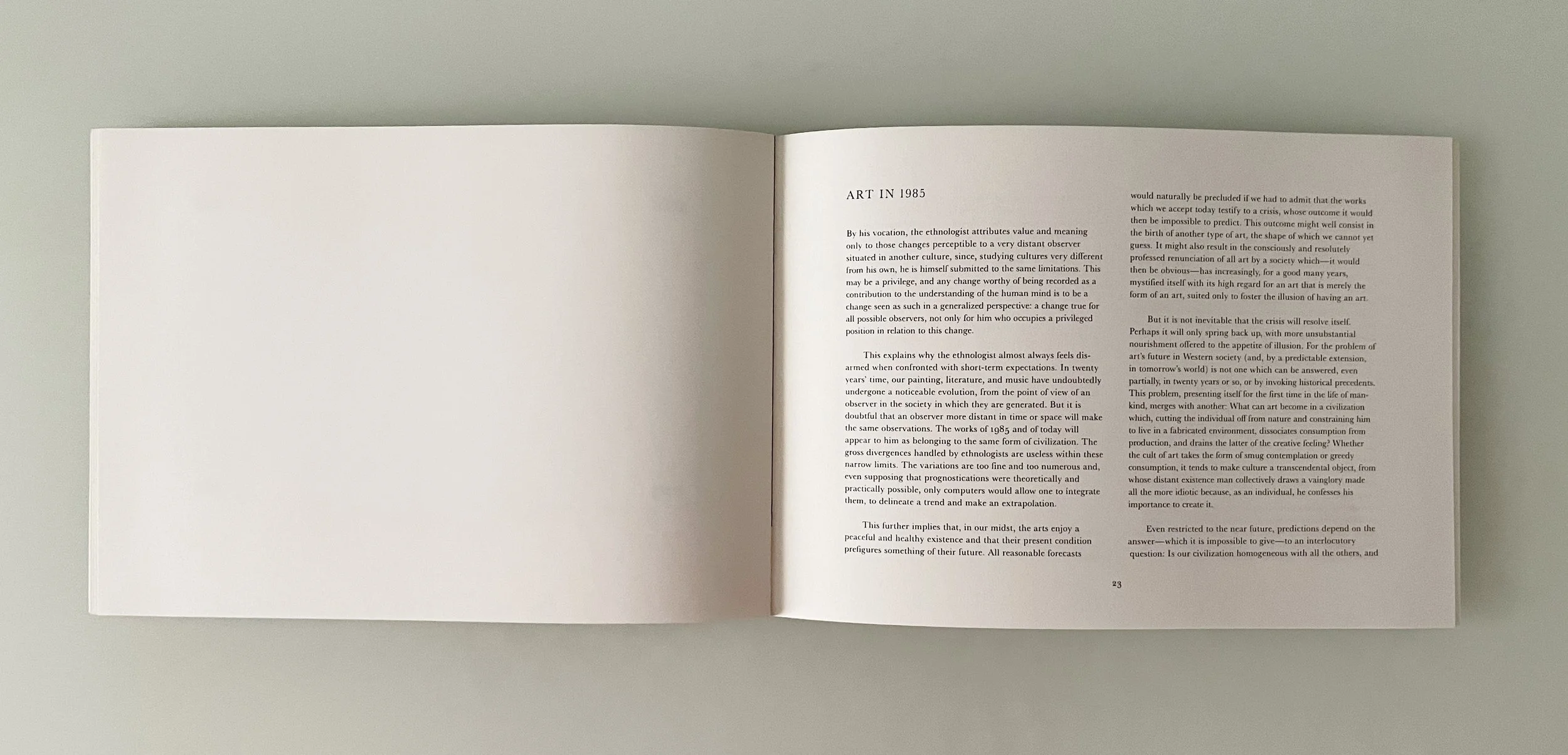
ART IN 1985
By his vocation, the ethnologist attributes value and meaning only to those changes perceptible to a very distant observer situated in another culture, since, studying cultures very different from his own, he is himself submitted to the same limitations. This may be a privilege, and any change worthy of being recorded as a contribution to the understanding of the human mind is to be a change seen as such in a generalized perspective: a change true for all possible observers, not only for him who occupies a privileged position in relation to this change.
This explains why the ethnologist almost always feels dis-armed when confronted with short-term expectations. In twenty years' time, our painting, literature, and music have undoubtedly undergone a noticeable evolution, from the point of view of an observer in the society in which they are generated. But it is doubtful that an observer more distant in time or space will make the same observations. The works of 1985 and of today will appear to him as belonging to the same form of civilization. The gross divergences handled by ethnologists are useless within these narrow limits. The variations are too fine and too numerous and, even supposing that prognostications were theoretically and practically possible, only computers would allow one to integrate them, to delineate a trend and make an extrapolation.
This further implies that, in our midst, the arts enjoy a peaceful and healthy existence and that their present condition prefigures something of their future. All reasonable forecasts would naturally be precluded if we had to admit that the works which we accept today testify to a crisis, whose outcome it would then be impossible to predict. This outcome might well consist in the birth of another type of art, the shape of which we cannot yet guess. It might also result in the consciously and resolutely professed renunciation of all art by a society which-it would then be obvious-has increasingly, for a good many years, mystified itself with its high regard for an art that is merely the form of an art, suited only to foster the illusion of having an art.
But it is not inevitable that the crisis will resolve itself. Perhaps it will only spring back up, with more unsubstantial nourishment offered to the appetite of illusion. For the problem of art's future in Western society (and, by a predictable extension, in tomorrow's world) is not one which can be answered, even partially, in twenty years or so, or by invoking historical precedents. This problem, presenting itself for the first time in the life of man-kind, merges with another: What can art become in a civiljzation which, cutting the individual off from nature and constraining him to live in a fabricated environment, dissociates consumption from production, and drains the latter of the creative feeling? Whether the cult of art takes the form of smug contemplation or greedy consumption, it tends to make culture a transcendental object, from whose distant existence man collectively draws a vainglory made all the more idiotic because, as an individual, he confesses his importance to create it.
Even restricted to the near future, predictions depend on the answer-which it is impossible to give-to an interlocutory question: Is our civilization homogeneous with all the others, and may one draw conclusions from what happened and is still happening in the former in order to predict what will happen in the latter? Or else: Are we dealing with entirely different forms, and, in this case, how will their relationship be defined? At first glance, viruses, intermediate organisms between life and inert matter, represent a particularly humble form of the former. And yet, they need other living beings in order to reproduce themselves. Thus, far from being able to precede them in evolution, viruses presuppose other beings and exemplify a relatively advanced state. On the other hand, the reality of a virus is almost of an intellectual order. In effect, its organism is reduced practically to the genetic formula that it injects into simple or complex beings, thus forcing their cells to betray their characteristic formula in order to obey its own and to manufacture beings like itself.
In order for our civilization to appear, the previous and simultaneous existence of other civilizations was necessary. And we know, since Descartes, that its originality consists essentially of a method which, because of its intellectual nature, is not suited to generating other civilizations of flesh and blood, but one which can impose its formula on them and force them to become like it. In comparison with these civilizations-whose living art expresses their corporeal quality because it relates to very intense beliefs and, in its conception as much as in its execution, to a certain state of equilibrium between man and nature-does our own civilization correspond to an animal or viral type? Had one to choose in favor of the latter hypothesis, it could be foretold that in twenty years the morbid hunger which drives us to gulp down all forms of past and present art in order to elaborate our own will experience a growing difficulty in satisfying itself.
Faced with those already three-quarters-dried-up, soon-lo-be-polluted wellsprings still provided by the flesh-and-blood societies in our museums and exhibitions, a lack of appetite will replace competition. Without any great change on the surface, it will be understood better than today perhaps that a society bears its art like a tree its flowers, as a function of their being rooted in a world which neither one nor the other claims to make entirely its own.
Claude Levi-Strauss
From Structural Anthropology, Volume 11, by Claude Levi-Strauss.
Copyright© 1976 by Claude Levi-Strauss. Reprinted by permission of Basic Books, Inc., Publishers.